
Welcome to our class page! We are excited to share our learning with you this year.
Our class team is Mrs Kemlo (Class teacher), Mr Moore and Mrs Rose.
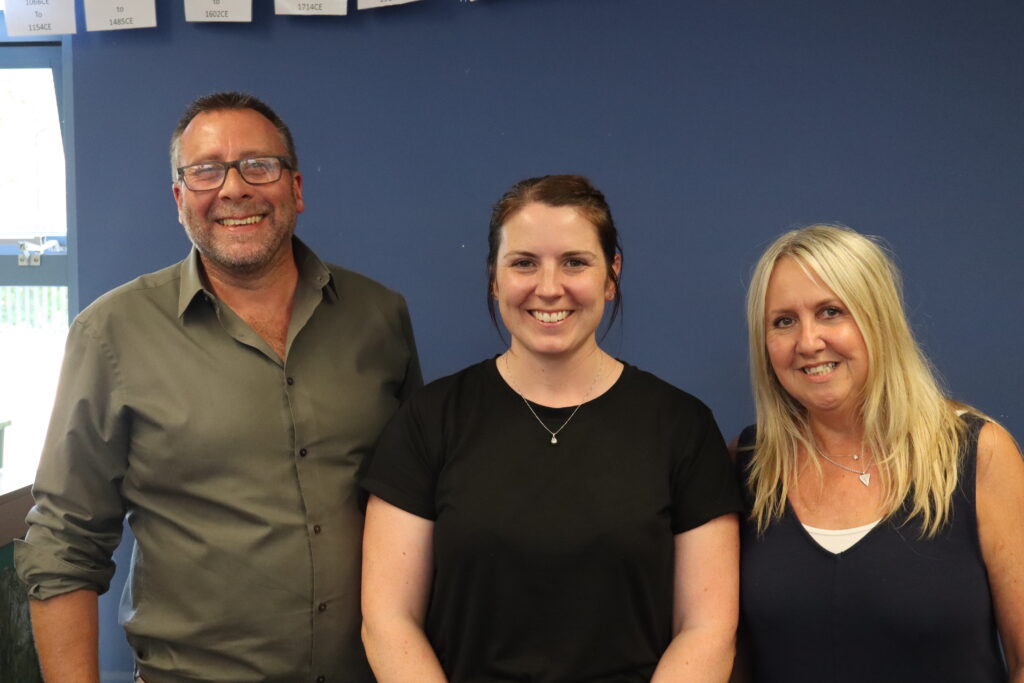
We are really looking forward to welcoming you into class in September. We can’t wait to show you all our learning and play. As a class, we work together to celebrate and value the success of everyone.
Literacy
This term in English, our learning will be centred around the story The Hodgeheg. We will begin with a series of reading-focused weeks, allowing children to become familiar with the text, develop their comprehension skills, and build confidence in discussing what they have read.
Using this engaging story as a foundation, children will then develop their reading and writing skills through a range of creative activities. In poetry, they will explore and write haikus and cinquains inspired by nature, animals, and the changing seasons, with a focus on rich descriptive language and vivid imagery. In fiction, children will plan and write their own animal adventure stories, learning to structure their writing with a clear beginning, middle, and end while using ambitious and engaging vocabulary.
Alongside this, our non-fiction work will involve creating fact files about hedgehogs. Children will learn how to present information clearly using headings and factual language, while exploring hedgehogs’ habitats and how they live.
Maths
In Maths, children will continue working in small, ability-based groups to build and strengthen their understanding of key mathematical concepts. Each group will focus on areas suited to their stage of learning, allowing for targeted teaching and appropriate support.
At the start of the term, our focus will be on fractions, as well as multiplication and division. We will continue to use the “build it, draw it, write it” approach to help children develop a deeper understanding by exploring concepts in practical, visual, and written ways.
Throughout the term, pupils will build confidence in core skills, apply their knowledge to problem-solving tasks, and further develop their reasoning and fluency across a range of mathematical concepts.
Science
Summer Term
This term in Science, children will explore a range of engaging topics linked to the natural world. In the first half of the term, we will focus on living things and their habitats. Pupils will learn how to group plants and animals according to their features, such as their appearance and the environments in which they live. This learning links closely with our class text The Hodgeheg. Children will also begin to use simple classification keys to identify different species in both our local area and wider environments, while developing an understanding of how habitats can change over time and the effects this can have on living things.
In the second half of the term, our focus will move to rocks. Children will compare and group different types of rocks based on their physical properties, including colour, texture, and hardness. They will learn how fossils are formed over time and develop an understanding that soil is made from a mixture of rock and organic matter, such as decayed plants and animals.
PE
Summer Term
This term in PE, children will be taking part in swimming lessons. They will develop their confidence and competence in the water, focusing on key skills such as floating, breathing techniques, and basic strokes. Pupils will also learn about water safety and how to move effectively in the water.
Swimming sessions will support children in building strength, coordination, and overall fitness, while encouraging perseverance and confidence in a new environment.
Our Swimming day is Wednesday. Children will need to bring:
- a suitable swimming costume or trunks
- a towel
- a swimming cap (if required)
Foundation Subjects
History
This term in History, children will explore the Medieval period, developing their understanding of how the past has shaped Britain and the wider world. They will place key events on a timeline to strengthen their sense of chronology and examine themes across different periods. Pupils will also study an aspect of local history from beyond 1066, helping them make meaningful links to their own area. Throughout the unit, they will build enquiry skills by asking and answering historically valid questions, comparing similarities and differences over time, and selecting relevant information from a range of sources. They will also begin to understand how knowledge of the past is constructed using historical evidence.
Geography
In Geography, children will extend their knowledge of the world by locating countries using maps, focusing on Europe, North America and South America. They will explore environmental regions and key physical and human features, including major countries and cities. Pupils will develop confidence using atlases, globes and digital maps, and will learn about aspects of physical geography such as coasts and rivers, alongside human geography topics like settlements and cities, helping them understand how people and places are connected.
Art
This term in Art, children will explore sculpture through the work of Nils-Udo, focusing on the relationship between art and nature. They will investigate how natural materials can be used creatively to produce sculptural pieces, exploring texture, form, movement and expression. Using resources such as sticks, leaves and other found objects, pupils will experiment with creating their own nature-inspired artwork. Their sketchbooks will capture their ideas and development as they observe, design and create their own sculptures influenced by the natural environment.
Music
This term in Music, children will focus on singing and performing with expression. They will develop their understanding of lyrics, beat, rhythm and poetry, learning to sing in time and with increasing confidence. Pupils will perform both individually and as part of a group, building their confidence and stage presence. They will also begin to identify how many beats are in a bar when listening to different pieces of music, helping them understand musical structure.
Computing
In Computing, children will create their own video trailers. They will begin by exploring the purpose of trailers and how they engage an audience, before planning their ideas using a storyboard. Pupils will consider features such as camera angles and shot types, and will learn how to import images and videos into editing software, add text and use transitions. They will also evaluate their own and others’ work to help improve their digital creations.
RE
This term in RE, children will take part in Philosophy for Children, exploring the question: how do we decide what is right or wrong? They will discuss how belonging to groups involves rules and why these are important for communities. Pupils will consider how beliefs, including religious views, can influence behaviour and values, and how ideas about right and wrong can be shaped by others. Through discussion and reflection, they will explore how people express their moral views and recognise that different perspectives exist.
PSHE
In PSHE, children will learn about economic wellbeing and develop their understanding of money and the world of work. They will explore different ways of paying for things and consider when each might be useful. Pupils will learn about budgeting and how it helps manage money, as well as reflect on how they might feel in different financial situations. They will also consider how spending choices can affect others and the environment. In addition, children will explore a range of jobs, understand how skills and interests link to careers, and challenge stereotypes.
MFL (French)
This term in French, children will build their vocabulary by identifying cognates to help them understand fruit-related words. They will also learn to use definite articles correctly, recognising how they change depending on the gender of the noun. This will support pupils in recognising patterns in the language and forming simple, accurate phrases with increasing confidence.
Design and Technology (DT)
This term in DT, children will focus on developing their sewing skills, with a particular emphasis on joining two pieces of fabric together. They will learn and practise a range of simple stitching techniques, building confidence in creating secure and neat joins.
Personal Developmental Play
At Fortuna School, play is a meaningful and purposeful part of our curriculum, rather than simply a break from learning. It is carefully planned and used as an important tool to support children’s social, emotional and cognitive development. We use the Boxall Profile to help us understand and assess each child’s needs, ensuring that play opportunities are tailored to support their individual development.
Play is embedded throughout the school day, both within lessons and during dedicated times for children to explore, unwind and interact with others. These experiences help children to recognise and express their emotions, build confidence and develop resilience within a safe and nurturing environment. Play also supports social development, encouraging children to collaborate, share ideas and resources, take turns, and solve problems together.
Homework
Useful Websites
Below are websites that you may find interesting or useful.